Using The Magical Rule Of Three When You Decorate
Learn the rule of three, the simple decorating principle designers swear by. See how grouping in odd numbers creates instant balance and beauty in any room.
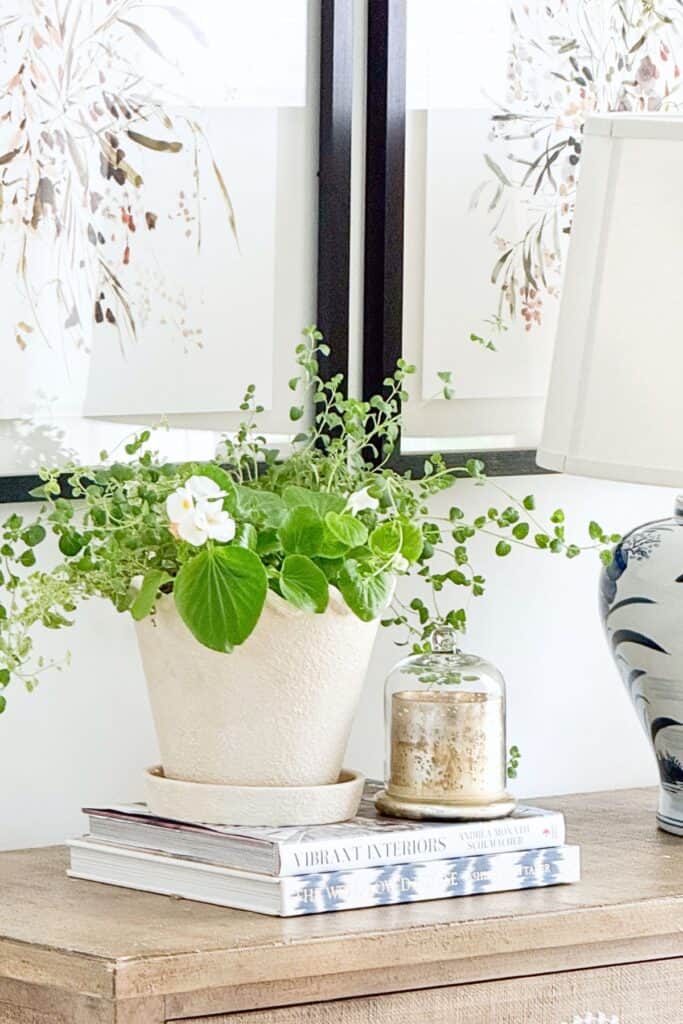
I found the rule of three by accident, and you probably have too. Long before I ever had a name for it, I noticed that when I grouped three things together while decorating, they simply looked nicer. So I started doing it on purpose, again and again, in vignette after vignette.
That simple discovery got me curious about other design concepts too. Once I learned them and started using them throughout my home, everything looked better. The rule of three was really where it all began for me.
In decorating, the rule of three is the golden rule. It is so simple, and it works magically to create beauty and balance. It can be used in something as small as a vignette and as large as the layout of an entire room. Let’s go over the basics so you can start using the rule of three in your own home today.
Quick Start Box
The rule of three is a simple decorating principle that says objects grouped in odd numbers, especially three, are more pleasing to the eye than objects grouped in even numbers. Use it on shelves, mantels, coffee tables, wall art, and even with color and outdoor décor for an instantly more balanced home.
What Is The Rule Of Three
The rule of three is easily stated. A group of odd numbers is most pleasing to the eye, and a grouping of three is the most pleasing of all. This is a solid gold decorating rule. Our brains actually find the iconic grouping of three things to be beautiful.
I use this same concept far beyond decorating too. When I take a photograph or sit down to do something creative like watercolor, I find myself reaching for the same idea. Three trees in a landscape. Three main items in a still life. It seems the rule of three lives in art of every kind, not just in a vignette on a table.
This isn’t just a modern styling trend either. The idea goes back centuries. There’s an old Latin phrase, omne trium perfectum, which means everything that comes in threes is perfect. Photographers and artists call a version of this the rule of thirds. So when you use the rule of three in your home, you are borrowing a principle that has shaped art and design for a very long time.
🌿 TIP BOX: If you are new to decorating, the rule of three is the easiest place to start. It gives you an instant formula so you never have to guess how many items belong in a grouping.
How Our Eyes And Brain Respond To Groupings
Three is a magic number in the world of decorating and beyond. It is the secret to balanced design with beautiful visual depth. It’s all about our eye and mind connection. We are hardwired to find things grouped in threes visually pleasing.
Our eyes are also smarter than you think. They don’t count an item that the grouping sits on, or a container that corrals the other items, such as a runner or basket for a vignette or a rug for furniture, as part of the group. Things like baskets and trays actually define the grouping instead of adding to the count. Very smart!
Look at a simple vignette. If it had only one thing in it, the vignette would be boring. And more than five items are just too crowded. But three grouped together is just right. Goldilocks knew all about the just right of three!
🌿 TIP BOX: When you are unsure if a grouping feels right, step back ten feet and squint at it. Your eyes will tell you instantly if something is missing or if there is one too many.
A Little Vignette That Demonstrates The Rule
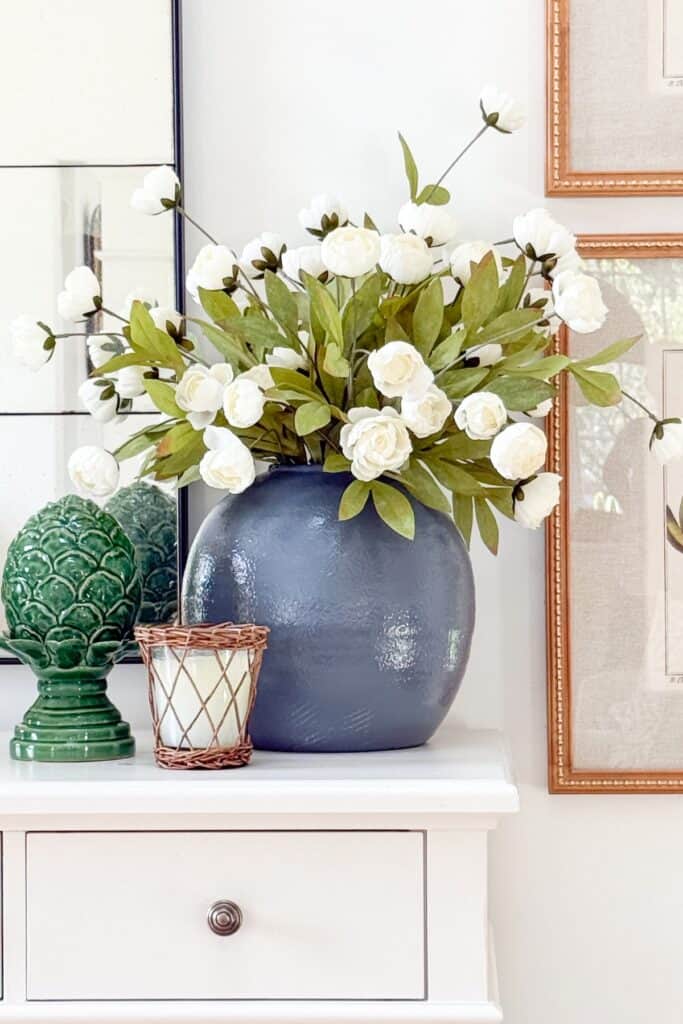
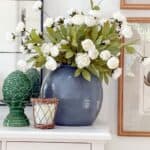
Look at this vignette on top of a dresser. A tall vase filled with white ranunculus, a green ceramic artichoke on its own pedestal, and a small woven candle tucked in beside them. Three pieces, three different heights, three different textures, and yet it all comes together as one beautiful grouping.
Notice how the eye moves easily from the tall, airy florals, down to the rounded artichoke, and over to the low, cozy candle. That variation in height and shape is what makes a grouping of three feel effortless rather than staged. Nothing here matches exactly, and that is exactly why it works.
🌿 TIP BOX: Notice how the candle’s woven basket, the artichoke’s glossy ceramic finish, and the vase’s matte texture all differ from one another. Mixing textures within a grouping of three adds richness without adding clutter.
How Our Eyes Read Layered And Stacked Items As One
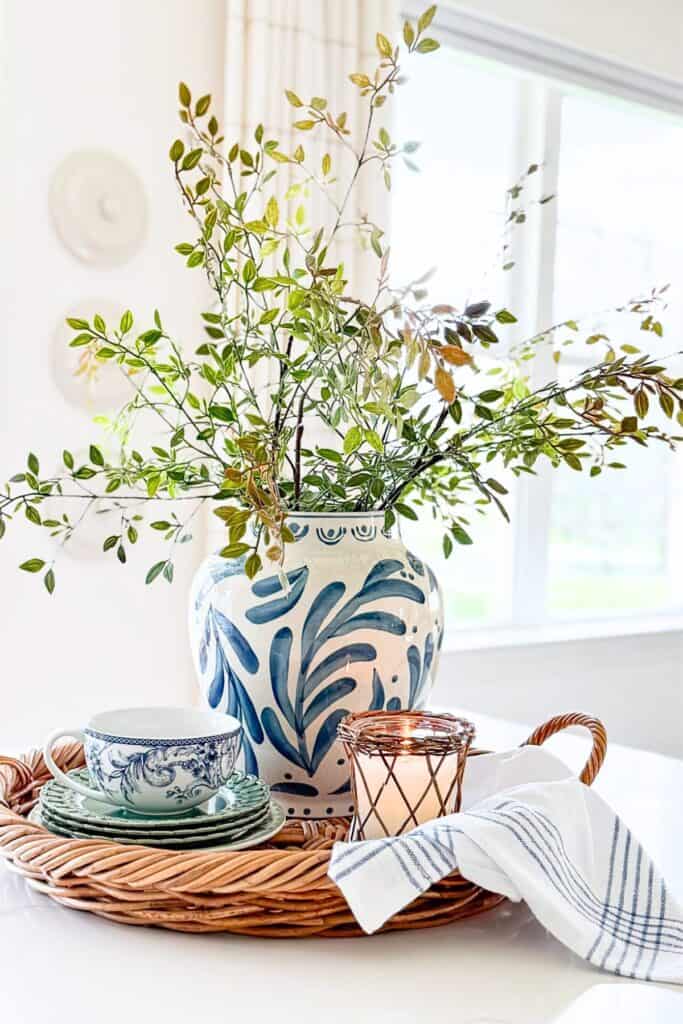
Look at this tray on the table. There is a stack of blue and white teacups and saucers, a woven candle lantern, a linen napkin, and my favorite hand painted vase filled with greenery. That could easily be four or five separate items. But because the tray corrals everything together, and because the cups and saucers are stacked, our eyes read this whole tray as one single grouping.
Layering decor like this adds wonderful interest to any grouping of three. I especially love stacking items on books, plates, and boxes to create different heights within a vignette. A short stack of books under a small plant, or a few plates layered beneath a candle, instantly gives you that variation in height we talked about earlier, all while still reading as one piece in your grouping of three.
So on this table, we really have three things. The tray of dishes, the vase of greenery, and the little glowing candle. Three, once again.
🌿 TIP BOX: A small stack of books works the same way. Slide a small plant or candle on top of a short stack, and your eyes will read the whole thing as one grouping, not two separate items.
Using The Rule Of Three On A Coffee Table
Our large coffee table is one place I love to create something interesting and beautiful using the rule of three. When I want to freshen it up, I grab items whose colors work together but whose textures are different, then I begin to play.
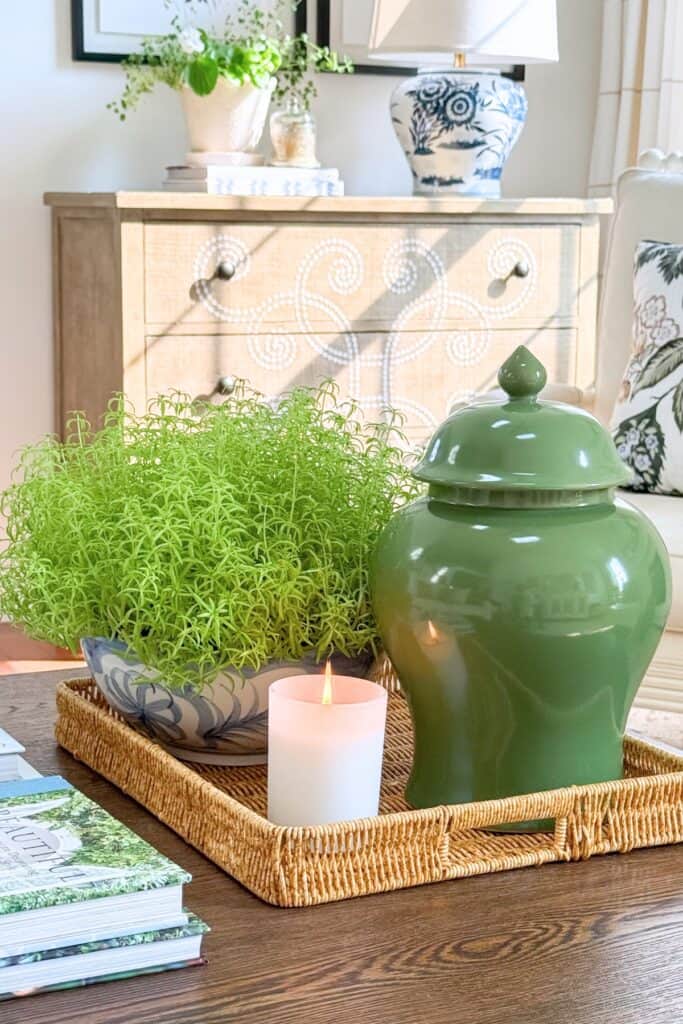
Take a look at what is happening on the tray in this vignette. There is a lush green plant, a green ginger jar with its lid, and a simple candle. Three pieces, three different textures, from the soft plant to the glossy ceramic to the matte candle. I also choose items in varying heights, so the ginger jar is just a bit taller, the plant sits mid height, and the candle stays low. That variation is what keeps your eyes moving happily across the tray instead of landing flat.
Just below the tray, there is a second grouping of three happening at the very same time. A woven basket of coasters sits beside two stacks of coffee table books. That is still a grouping of three, even though two of the three pieces are stacks rather than single items. Remember, a stack reads as one.
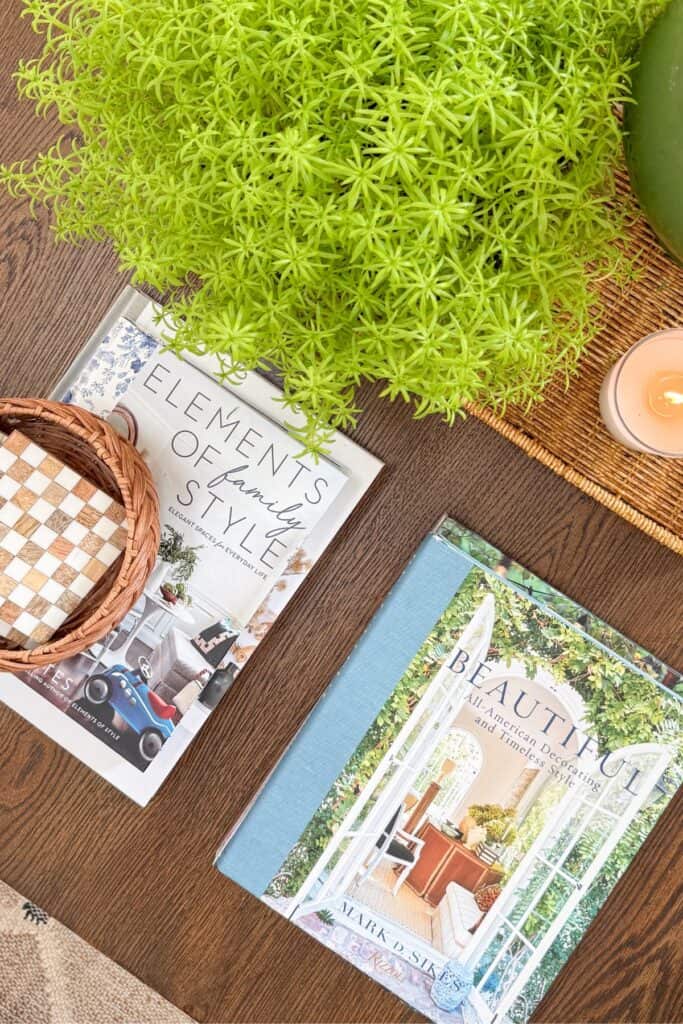
This is what makes the rule of three so versatile. You are not limited to one grouping on a coffee table. You can layer several groupings of three right beside each other, and as long as each one is visually distinct, your eyes will happily take in the whole table as a beautifully composed scene rather than a cluttered one.
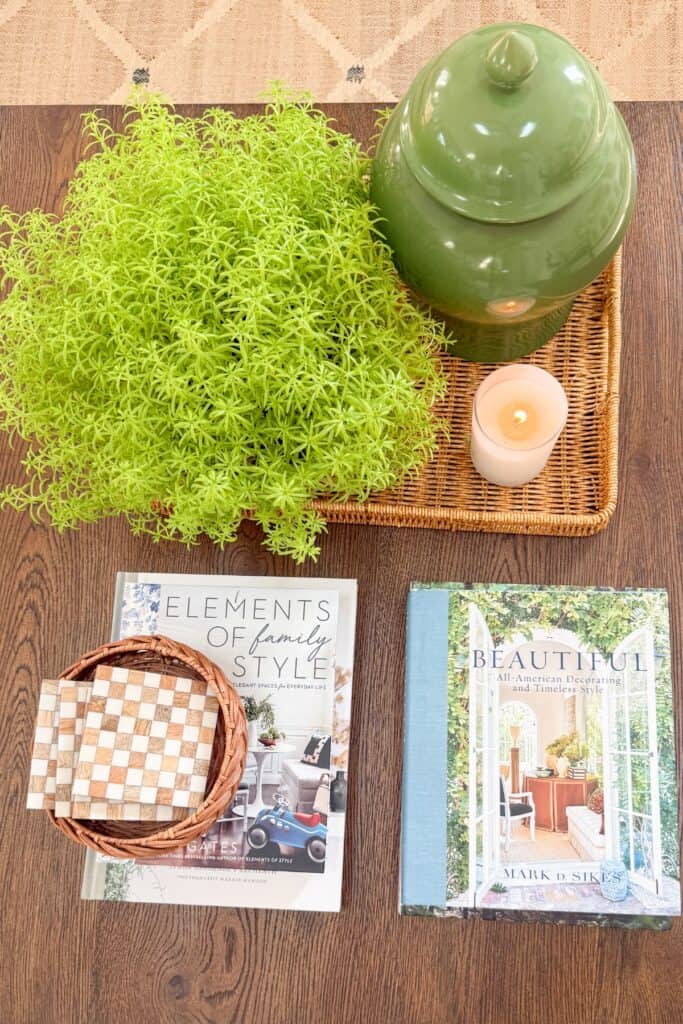
🌿 TIP BOX: When freshening up a coffee table, choose pieces in colors that already work together, but reach for different textures and varying heights, like a woven basket, a glossy jar, and a soft plant. The variety is what keeps the grouping interesting.
Using The Rule Of Three On A Mantel Or Shelf
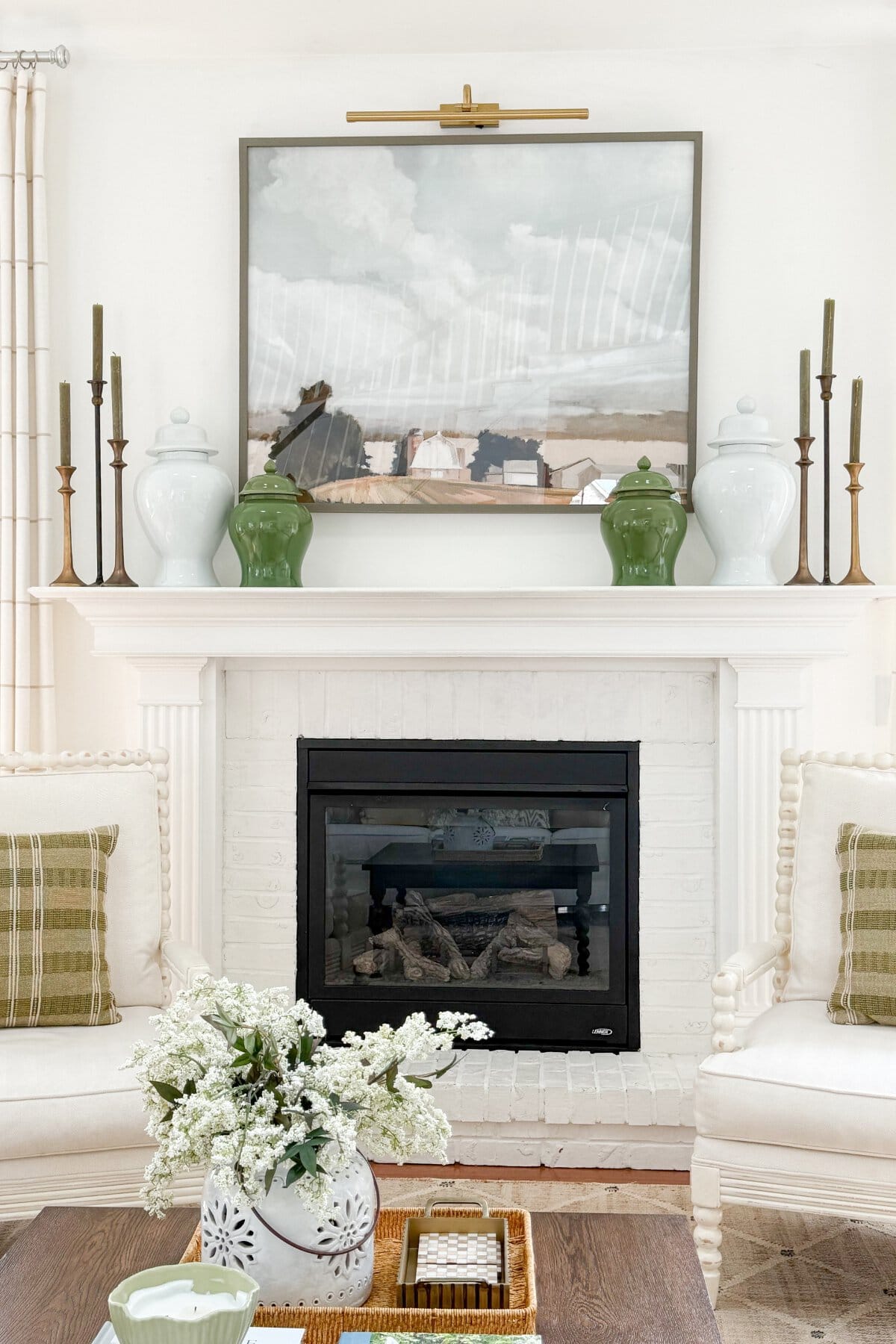
Above our mantel, we have a large painting of a bucolic farm scene, and I never want other decor competing with it. So instead of one grouping in the center, I like to decorate either side of the mantel with a few symmetrical items, and often those items are grouped in threes.
Look at this mantel. On each side, there is a pair of candlesticks in varying heights, along with a ginger jar in white and one in green. That is three distinct elements repeated on both sides, the candlesticks, the white jar, and the green jar, creating a grouping of three that mirrors itself across the mantel. Because both sides match, the whole arrangement feels calm and balanced, which lets the art stay the star of the show.
This an example of how the rule of three does not always mean one small vignette in the center of a mantel. It can also mean a repeated grouping of three, used symmetrically, so your eye has a satisfying rhythm to follow from one side to the other without ever pulling focus from what matters most in the room.
🌿 TIP BOX: If you have a piece of art or a mirror you want to keep as the focal point, try flanking it with a matching grouping of three on either side. Symmetry and the rule of three can absolutely work together.
Using The Rule Of Three With Pillows
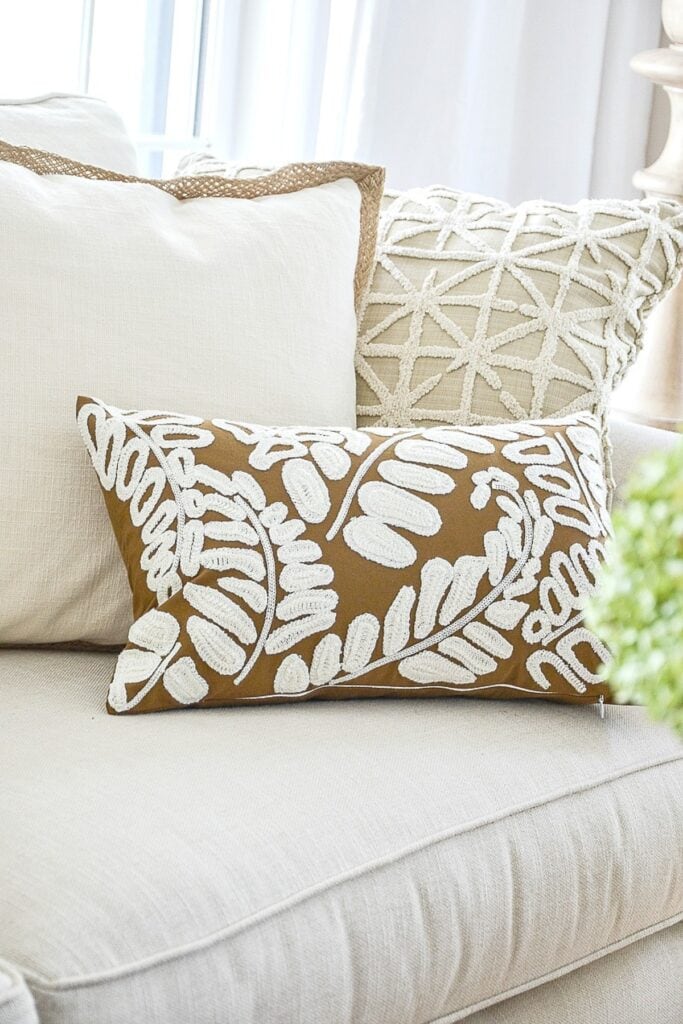
Pillows are one of the easiest ways to use the rule of three. I like to use three pillows as the back layer, whether against a headboard or tucked into the corner of a sofa. Three pillows the same size work beautifully, but a grouping of different sizes looks even more interesting.
Look at this trio on the sofa. There is a solid cream pillow with a woven jute trim, a textured cream lumbar pillow with an embroidered pattern, and a smaller camel brown pillow with a bold leaf design layered in front. Three different sizes, three different textures, and just enough pattern to keep things interesting without feeling busy.
This works especially well if there is texture, like a nubby cotton or linen, along with a mix of patterns. Three pillows also naturally vary in a way two matching pillows never can, since you have room for one solid, one textured, and one patterned piece.
🌿 TIP BOX: When choosing pillows for a grouping of three, let one lead with pattern, one lean on texture, and one stay solid. Varying the sizes as well gives your eyes even more to enjoy.
Using The Rule Of Three With Wall Art
Instead of hanging one large piece of art, try grouping three smaller pieces together. This instantly makes a wall feel curated and personal rather than like a single purchase. Choose three frames with a little variety in size, but keep a common thread running through them, like matching frame color, a shared color palette, or a similar subject.
🌿 TIP BOX: Lay your three art pieces on the floor first and live with the arrangement for a day before you hang anything. It is much easier to adjust spacing on the floor than to patch extra nail holes later.
Using The Rule Of Three With Color
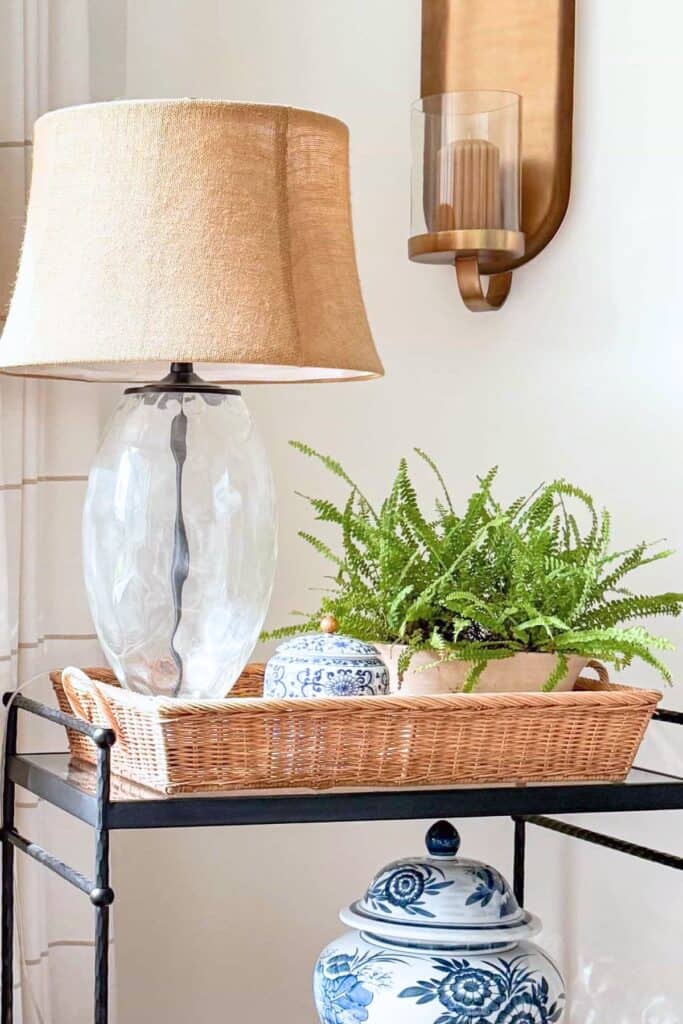
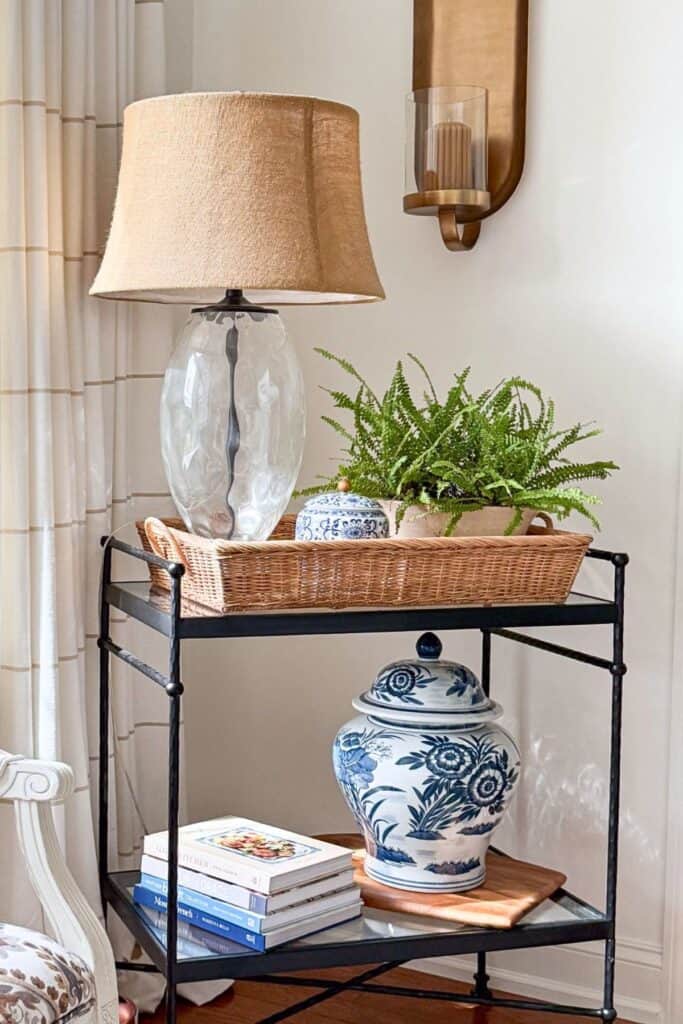
Color is an easy way to add the beauty of the rule of three to your home. Our home has a neutral base, which makes it simple to add pops of color that work well together. The bar cart is a great example of this in action. The base colors are warm neutrals, especially the camel burlap lampshade. I added a green plant and a couple of blue and white chinoiserie pieces to give the cart interest and depth.
Look at this tray on the bar cart. The woven basket and glass lamp base set a warm, neutral tone. A lush fern adds a pop of green. And a small blue and white ginger jar brings in that classic chinoiserie color. Three colors, three textures, working together instead of competing with one another.
That is really the rule of three at work in color form. A neutral base, a green accent, and a pop of blue and white. Many designers call this the sixty thirty ten rule. Sixty percent of a space is your dominant color, usually walls and large furniture. Thirty percent is a secondary color, often seen in upholstery or larger accessories. Ten percent is an accent color, the smallest pop, used in pillows, art, or little pieces like that ginger jar.
This is really the rule of three in a different form. Three colors, in three different proportions, working together to create a vignette, or an entire room, that feels intentional rather than random.
🌿 TIP BOX: If a space ever feels a little off but you cannot pinpoint why, count your colors. You may have four or five competing for attention instead of a clear, simple palette of three.
Using The Rule Of Three Outdoors
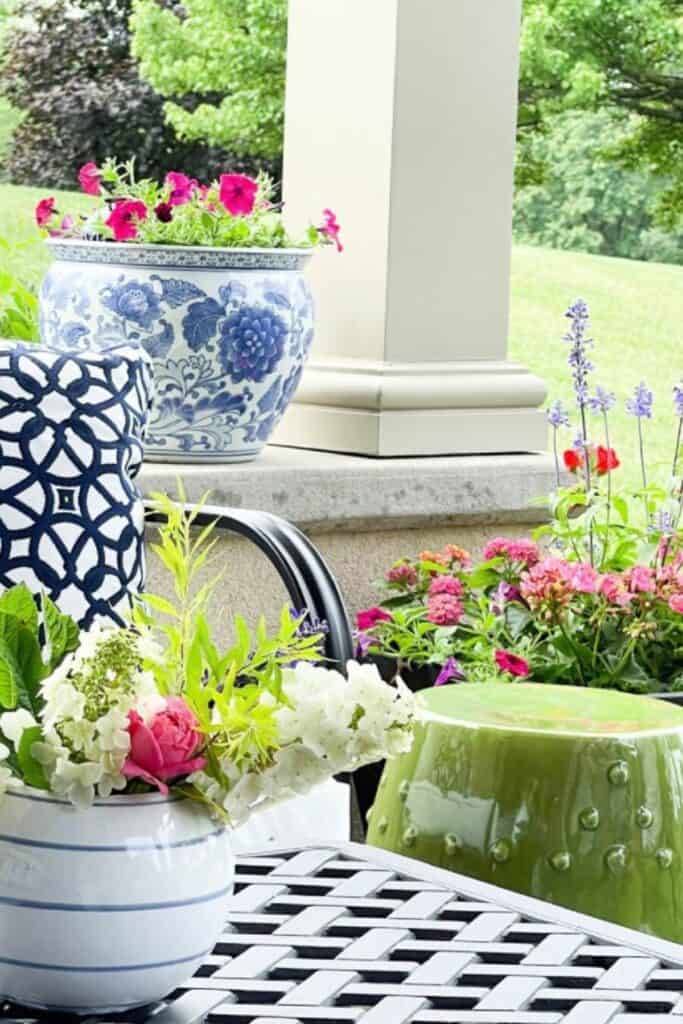
The rule of three is not only for the inside of your home. Look at this porch corner. There is a blue and white floral planter overflowing with pink petunias, a lower planter tucked in with vibrant blooms in pink, orange, and purple, and a white striped vase with hydrangea, roses, and greenery. Three planters, three different heights, and three slightly different color stories, all working together to make the whole corner feel lush and welcoming rather than matched and stiff.
Vary the pot heights and sizes the same way you would inside, and let one variety of flower spill a bit while another stands upright for contrast. On a patio or deck, this could mean three different sized planters, or a trio of pots grouped near a garden stool the way they are here. The same principle that makes a coffee table vignette feel right will make your outdoor spaces feel just as welcoming.
🌿 TIP BOX: Odd numbers work outdoors in groups of five and seven too, once you have more square footage to fill. Start with three and add from there.
When To Break The Rule Of Three
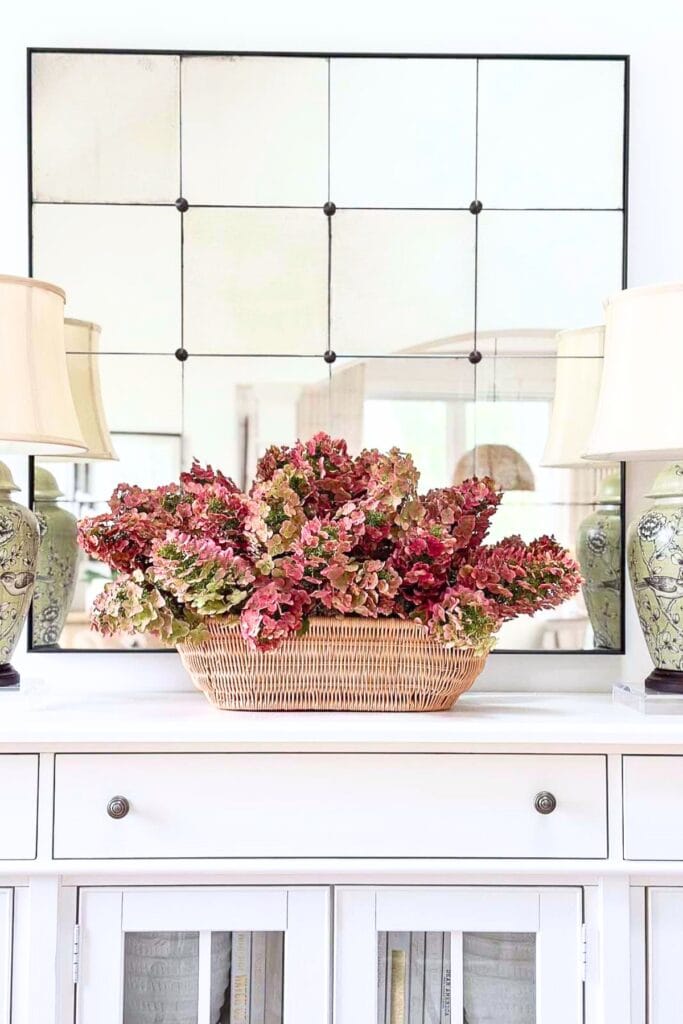
Every good rule has its exceptions, and the rule of three is no different. Most of the time, I create decor with three items, whether that is a small vignette, a pair of chairs and a table, or the room as a whole. But depending on the pieces I am working with, I sometimes break the rule, especially when I have one arrangement that can stand beautifully on its own.
Look at this hydrangea basket. It is a big, generous armful of blooms cut straight from our garden, and it does not need any company. Flanked by a pair of matching green lamps, it becomes the star of the vignette all by itself. Adding two more small items here would only compete with something that is already a complete statement.
The same idea applies to a simple vase of greenery on a mantel tray. Sometimes one lovely, full arrangement is enough, and the quiet space around it is what lets it shine.
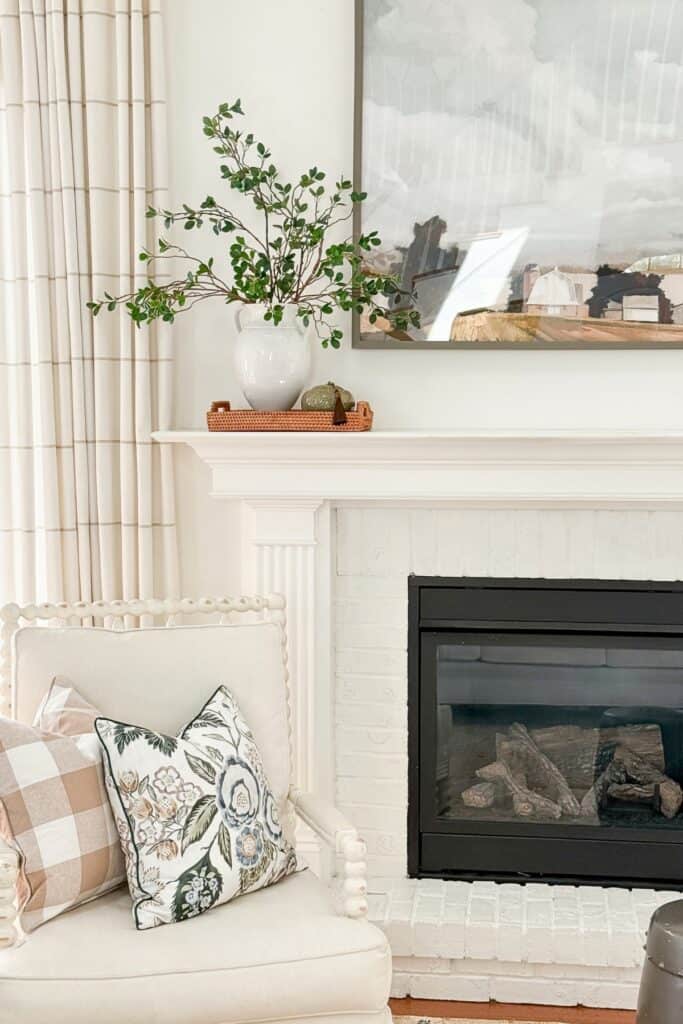
Think of the rule of three as your default setting, not a law. It is the place to start when you are unsure, but your own eye and the feeling you want a room to have should always have the final say.
🌿 TIP BOX: If a room feels too busy, resist the urge to add another grouping of three. Sometimes the most beautiful choice is empty space around one statement piece.
Questions You Might Be Asking About The Rule Of Three
Over the years, readers have asked me all kinds of questions about the rule of three. Here are a few of the ones I hear most often, along with how I answer them in my own home.
Yes, it really does. I use it in the living room, on the mantel, in the kitchen, and even out on the porch. Any spot where you are arranging decor can benefit from grouping in odd numbers.
Add a third item that shares a common thread, like color, material, or shape, rather than running out to buy a matching third piece. A little variety within the grouping is actually more visually interesting than three identical items, and it is usually sitting somewhere else in your home already.
It can. Think of a sofa, an accent chair, and a side table forming a seating grouping, or the pair of chairs and the table I mentioned earlier. The principle scales up as easily as it scales down to a coffee table vignette.
Absolutely, and our mantel is a good example of that. A repeated grouping of three on each side of a piece of art gives you both the calm of symmetry and the visual interest of odd numbered groupings at the same time.
More Ideas You Will Love
Here are a few more decorating concepts that pair beautifully with the rule of three and will help you keep building your decorating confidence.
How To Make Your Home Look Cohesive Using Simple Decorating Ideas
Rhythm is another design principle that works hand in hand with the rule of three, helping your eye move naturally through a room. This post breaks it down into simple, repeatable steps.
Simple Decorating: How To Decorate With Less
A helpful companion to knowing when to break the rule of three, this post explores the beauty of restraint and why less is often more in your decorating choices.
How To Decorate With What You Have: 20 Smart Ideas That Work
Before you buy anything new, this post shows you how to find fresh groupings of three using what is already in your home.
How To Decorate Your Home On A Budget: Simple Ideas That Really Work
Styling in threes does not have to cost a thing, and this post is full of budget-friendly ways to bring more beauty into your home.
20 Decorating Rules You Should Break For A Stylish Home
Since we just talked about when to break the rule of three, this post rounds out that idea with nineteen more decorating rules worth bending.
How To Choose The Right Table Lamp: Size, Scale, And Style
Lamps are often part of a vignette’s grouping of three, and this post walks you through choosing the right size and scale for your space.
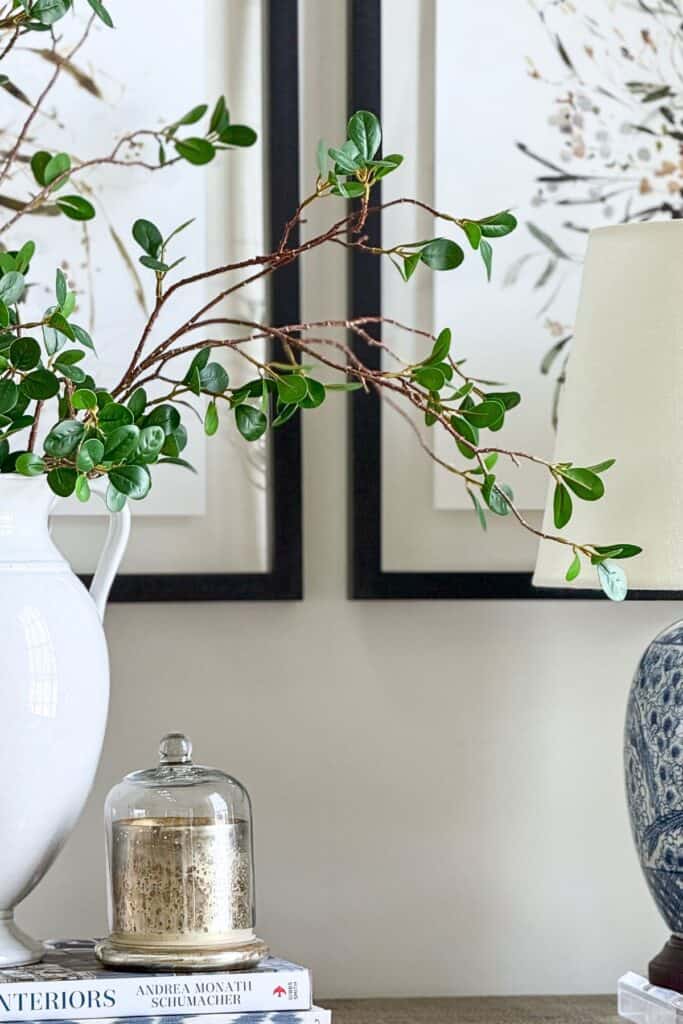
So now you know the basics about the magical rule of three. Try it on a coffee table, a mantel, a gallery wall, or even in your color palette, and watch how much more balanced your home begins to feel.
And remember, the rule of three is a wonderful place to start, but it does not have to be the last word. Trust your eye, and let one beautiful piece stand alone when it deserves to.
Happy decorating, friends…

Where did you get the white flower container on the first page?
Hi Janet, the containers are really lanterns I use as makeshift vases. I found them at Pottery Barn years ago. Once in a while I see them come back on their site.
Could you say more about “the rule of three” when arranging furniture in a room?
Two chairs with a small table in between them or a sofa and two end tables or a sofa and two chairs perpendicular to the sofa. A group of three looks lovely to our eyes!
Just love the neutral colors and the use of 3! I recently redecorated and put those tips to good use! Everything looks clean and crisp. Sp pleased with the outcome. Thanks so much!
Love the white tulips. Great ideas.
Are the burgundy hydrangeas on your white buffet real or artificial? If artificial, where did you purchase them?